
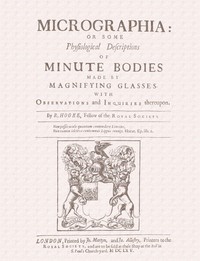
Micrographia by Robert Hooke
Okay, let's be clear: 'Micrographia' doesn't have a plot in the traditional sense. There's no villain or love story. Instead, the 'story' is the journey of Hooke's eye. He takes his homemade microscope and points it at whatever he can find. He looks at the point of a needle, which he discovers is rough and blunt. He examines a louse, a flea, and a fly's eye, drawing them in immense, terrifying detail. He slices a thin piece of cork and sees it's made of tiny, empty boxes, which he names 'cells.' He stares at mold and sees it as a miniature forest. Each observation is a short chapter, a little revelation. The book builds from simple objects to more complex ones, like insects and plants, charting his growing amazement at the complexity hidden in the mundane.
Why You Should Read It
You should read this because it captures a pure, unfiltered moment of wonder. Hooke isn't a distant historical figure here; he's an excited guy with a new toy, saying 'Wow, look at THIS!' His drawings are the star. They're beautiful, detailed, and sometimes grotesque (the flea plate is famous for a reason). More than that, the book makes you rethink how you see everything. After reading it, you'll look at a speck of dust or the edge of a leaf differently. It's a reminder that profound discovery often starts with simple, patient looking. Hooke's voice is curious and direct, which makes 350-year-old science feel surprisingly fresh.
Final Verdict
This book is perfect for curious minds, art lovers fascinated by scientific illustration, and anyone who enjoys primary sources from history. It's not a quick, breezy read—the 17th-century prose takes some getting used to—but it's incredibly rewarding. Think of it as an art book meets a science journal from the dawn of modern discovery. If you've ever been amazed by a close-up photo from nature, you owe it to yourself to meet the grandfather of that entire way of seeing. Just be prepared to start noticing the tiny world everywhere.
This title is part of the public domain archive. Preserving history for future generations.
Susan Clark
4 months agoA bit long but worth it.
Steven Lewis
1 year agoText is crisp, making it easy to focus.
Amanda Miller
1 year agoTo be perfectly clear, the storytelling feels authentic and emotionally grounded. I would gladly recommend this title.