
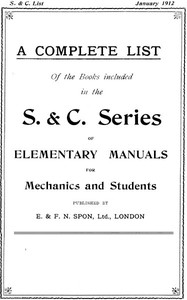
A Complete List of the Books Included in the S. & C. Series of Elementary…
On the surface, this book does exactly what its title promises. It presents a meticulous, seemingly exhaustive catalog of titles that once belonged to a forgotten educational series published by the mysterious "S. & C." There are no stories here, no characters, no plot twists in the traditional sense. Just names of books. Elementary Geography, First Principles of Chemistry, A Child's History of Rome. Page after page of them.
The Story
The 'story' is the absence of one. You're handed this bare-bones inventory, and your mind immediately starts filling in the blanks. Who were the students using these books? What did the pages look like? Were the authors passionate experts or bored compilers? The book becomes a launchpad for your own imagination. Each listed title is a door to a room you can never enter. You begin to construct a phantom curriculum, a whole world of early 20th-century learning, built entirely from this skeletal framework. The central tension isn't in the text; it's between the cold, factual list and the vibrant, lost reality it hints at.
Why You Should Read It
This book surprised me. It’s a meditation on loss, but also on curiosity. It made me think about all the everyday things—textbooks, pamphlets, instruction manuals—that shape a culture and then vanish without a trace. There’s a quiet, persistent melancholy to it, but it’s not depressing. It’s more like the feeling you get in a second-hand bookstore, wondering about the hands that held a book before you. It celebrates the human impulse to document and systematize knowledge, even as it laments how fragile those systems can be. You finish it not with answers, but with better, more interesting questions.
Final Verdict
This is a niche read, but a powerful one. It's perfect for bibliophiles, archivists, and anyone fascinated by the ghosts of history. If you love the smell of old paper and the mystery of marginalia, you'll find a friend in this book. It's not a page-turner; it's a thought-provoker. I'd also recommend it to writers looking for a unique example of how constraint can breed creativity. Just don't go in expecting a novel. Go in expecting a key to a library that no longer exists, and prepare to be quietly mesmerized by the echo.
You are viewing a work that belongs to the global public domain. Enjoy reading and sharing without restrictions.
Barbara Miller
1 year agoI had low expectations initially, however the narrative structure is incredibly compelling. I learned so much from this.
James Johnson
4 days agoVery interesting perspective.
George Jackson
1 year agoWithout a doubt, the atmosphere created is totally immersive. Highly recommended.
Dorothy Flores
8 months agoTo be perfectly clear, it challenges the reader's perspective in an intellectual way. A valuable addition to my collection.

Jackson Hernandez
1 year agoI had low expectations initially, however it challenges the reader's perspective in an intellectual way. One of the best books I've read this year.