
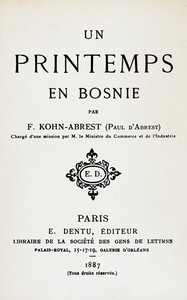
Un printemps en Bosnie by Frédéric Kohn-Abrest
Frédéric Kohn-Abrest's Un printemps en Bosnie is a travelogue written in the spring of 1889. The book is his personal record of a journey through Bosnia and Herzegovina, which had recently come under Austro-Hungarian administration. We follow him as he moves from town to town, observing everything from bustling markets and coffee houses to remote villages and ancient fortresses.
The Story
There isn't a traditional plot with a beginning, middle, and end. Instead, the 'story' is the journey itself. Kohn-Abrest describes the landscapes—the rugged mountains and green valleys—and, more importantly, the people. He talks with Austrian officials, local Muslim leaders, Orthodox Christian peasants, and Jewish merchants. He notes the new railroads being built next to old caravan routes, and the European-style buildings going up in Sarajevo. The narrative is a series of sketches and conversations that slowly build a picture of a society in flux, trying to find its footing under a new foreign power.
Why You Should Read It
What makes this book special is its immediacy. This isn't a historian looking back; it's a man writing down what he saw that day. You feel his curiosity, his occasional confusion, and his genuine effort to understand. He doesn't always have the answers, and he sometimes carries the biases of his time, but that honesty is compelling. It lets you see the region not as a chessboard for empires, but as a living place where real people were navigating a confusing new reality. The descriptions of daily life—the food, the customs, the social tensions—are incredibly vivid. It turns a historical period into something you can almost touch and smell.
Final Verdict
This book is perfect for readers who love immersive travel writing or primary-source history. If you enjoy books that drop you into another time and let you wander around, you'll love this. It's also a great, human-scale read for anyone interested in Balkan history, offering a ground-level view you won't get from a textbook. Just be ready for a slow, observational pace—it's a thoughtful walk through the past, not a thrilling race. For a glimpse of Bosnia through the eyes of a 19th-century traveler, it's a unique and rewarding trip.
This work has been identified as being free of known copyright restrictions. Use this text in your own projects freely.
Joseph Harris
1 month agoThe fonts used are very comfortable for long reading sessions.



Jessica Wilson
1 year agoFrom the very first page, it manages to explain difficult concepts in plain English. Don't hesitate to start reading.