
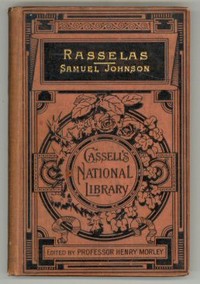
Rasselas, Prince of Abyssinia by Samuel Johnson
Published in 1759, Rasselas, Prince of Abyssinia is often called a philosophical fable. It's not a novel in the modern sense with a twisting plot, but more of a thoughtful journey. Samuel Johnson wrote it quickly to pay for his mother's funeral, which somehow makes its deep questions about life and happiness even more poignant.
The Story
Prince Rasselas is born into a secluded, perfect valley in Abyssinia (modern-day Ethiopia). This 'Happy Valley' is a gilded cage of pleasure and beauty, where every want is provided for. Yet, Rasselas grows restless and deeply unhappy. He convinces his sister, Nekayah, and the wise poet, Imlac, to help him escape. Together, they travel to Egypt to observe how different people live and to find the true 'choice of life.' They interview a cross-section of society: a simple shepherd, a stoic hermit, wealthy businessmen, learned astronomers, and even powerful rulers. In each encounter, they find that no single way of living guarantees happiness. Every path comes with its own unique set of disappointments, worries, and compromises.
Why You Should Read It
What struck me is how this isn't a stuffy old text. Johnson's voice is clear, witty, and often gently sarcastic. He doesn't give easy answers. Instead, the book feels like a honest conversation with a very smart, slightly world-weary friend. Rasselas and his crew are like us—they have a deep itch, a feeling that there must be more, and they go looking for it in all the places we still do: in nature, in solitude, in money, in knowledge, in power. The fact that they come up short every time is somehow comforting. It reminds you that the search for a perfect, static state of happiness might be the problem itself. The trio's dynamic is great, too; they debate and challenge each other, making their journey feel real.
Final Verdict
This is a perfect book for thinkers, ponderers, and anyone who has ever felt a little lost in a world full of options. If you enjoy authors like Albert Camus or modern essays on mindfulness and purpose, you'll find a kindred spirit in old Sam Johnson. It's also a fantastic, digestible entry point into classic literature because it's short, its language is direct, and its central question is timeless. Don't expect a neat, happy ending—expect a wiser, more grounded beginning to your own thoughts about what makes a life worth living.
This work has been identified as being free of known copyright restrictions. Distribute this work to help spread literacy.
Thomas Gonzalez
1 year agoPerfect.
Mary Robinson
1 year agoI had low expectations initially, however the plot twists are genuinely surprising. Thanks for sharing this review.
Nancy King
1 year agoI was skeptical at first, but the character development leaves a lasting impact. I would gladly recommend this title.
Elijah Young
1 year agoI didn't expect much, but the storytelling feels authentic and emotionally grounded. I couldn't put it down.

Elizabeth Williams
7 months agoGood quality content.