
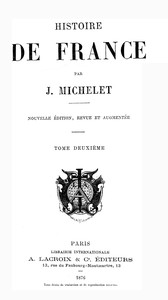
Histoire de France 814-1189 (Volume 2/19) by Jules Michelet
Jules Michelet's Histoire de France isn't a dry timeline. It's a grand, sweeping story where the land and its people are the main characters. This second volume picks up after Charlemagne's empire shatters. We see his grandsons tear Europe apart, leading to a long, messy period where France barely holds together. Kings are weak, Vikings raid the coasts, and local lords grab power. But Michelet insists this isn't just a 'Dark Age' of chaos. This is where France is really made.
The Story
Michelet guides us through the rise of the Capetian dynasty, starting with Hugh Capet. But the plot isn't about their glory. It's about how, in the shadow of shaky royal authority, ordinary life organized itself. He shows us villages forming communes to protect themselves, the church becoming a massive landowner and moral force, and the slow crystallization of a French identity separate from the German Empire. The narrative builds toward the Crusades, not just as military adventures, but as events that changed how France saw the world and itself. The 'story' is the painful, fascinating birth of a national consciousness from a thousand local struggles.
Why You Should Read It
You should read this for Michelet's voice. He's in the room with you, passionate and sometimes furious. He makes you feel the mud of a medieval field and the weight of feudal obligation. His great theme here is liberty—not the kind declared by kings, but the kind forged by people in their towns and fields. He champions the underdog and sees the growth of communal charters and local justice as the true foundation of France. It's history from the ground up, written with a poet's eye for detail and a reformer's zeal. You're not just learning what happened; you're getting a fiercely argued perspective on why it mattered.
Final Verdict
This is perfect for anyone who finds most history books too bland. It's for the reader who wants to feel the past, not just memorize it. If you love Simon Schama's narrative style or the big ideas of writers like Thomas Carlyle, you'll meet their brilliant, fiery ancestor in Michelet. Be warned: it's a 19th-century book, so some of his theories are dated. But that's part of the fun. You're engaging with a masterpiece of historical storytelling that helped shape how we think about nations and people. It's not an easy beach read, but for a dose of profound, passionate history, it's incredibly rewarding.
This content is free to share and distribute. Thank you for supporting open literature.
Oliver Thompson
1 year agoThe index links actually work, which is rare!
Lucas Lewis
7 months agoVery interesting perspective.
Jackson Thompson
11 months agoClear and concise.
James Moore
1 year agoHelped me clear up some confusion on the topic.





Ethan Perez
1 year agoWow.