
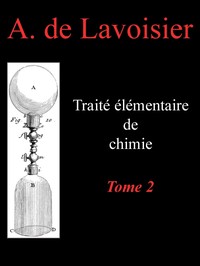
Traité élémentaire de chimie, tome 2 by Antoine Laurent Lavoisier
Let's be clear from the start: this is not a novel. Antoine Lavoisier's 'Traité élémentaire de chimie' (Elementary Treatise on Chemistry) is the foundational textbook of modern chemistry. Volume 2, published in 1789, is where he lays out the practical system born from the revolutionary theories he introduced in Volume 1.
The Story
There's no plot in the traditional sense, but there is a clear narrative arc: the overthrow of an old world. Lavoisier is dismantling the chaotic, ancient system of alchemy and its central flawed theory—phlogiston. In its place, he builds a new edifice based on careful measurement, clear definitions, and logical order. This volume is the 'how-to' guide. He systematically walks through the chemistry of acids, salts, and chemical combinations, using his new language of elements and compounds. He details experiments that anyone could replicate, insisting on precision and quantitative results. The 'story' is watching a brilliant mind organize a whole field of messy knowledge into something coherent and true.
Why You Should Read It
You read this to touch history. It's humbling to see the birth of ideas we take for granted. When Lavoisier names 'oxygen' or explains combustion, you're witnessing the moment these concepts entered human understanding. His writing is surprisingly clear and confident. He's not just reporting facts; he's making a persuasive argument for a whole new way of thinking. There's a palpable sense of excitement, of someone standing on the edge of a new frontier and mapping it out for the first time. It makes you appreciate how hard-won our basic scientific knowledge really is.
Final Verdict
This book is a must for anyone fascinated by the history of science and ideas. It's perfect for the curious reader who wants to go beyond just hearing that Lavoisier was important and actually see his genius at work. If you enjoy biographies of great thinkers or stories about paradigm shifts, you'll find the raw material of one of the biggest shifts right here. It does require some patience—it's an 18th-century scientific text, after all—but the payoff is a direct conversation with one of the architects of the modern world. Approach it not as a homework assignment, but as an archaeological dig into the foundations of science itself.
This is a copyright-free edition. It serves as a testament to our shared literary heritage.
Kimberly Davis
9 months agoHonestly, the clarity of the writing makes this accessible. I couldn't put it down.
Lisa Hill
9 months agoHonestly, it challenges the reader's perspective in an intellectual way. Exactly what I needed.
John King
1 year agoWithout a doubt, the flow of the text seems very fluid. I will read more from this author.
Jessica Wright
1 year agoAmazing book.

John Johnson
1 year agoI stumbled upon this title and the clarity of the writing makes this accessible. A true masterpiece.