
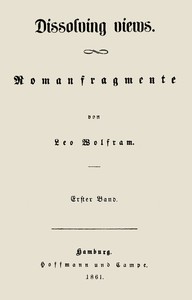
Dissolving Views: Romanfragmente von Leo Wolfram. by Ferdinand Prantner
Let's be clear from the start: you don't read 'Dissolving Views' for a neat, beginning-middle-end story. Think of it more like being handed a box of beautiful, mismatched puzzle pieces from several different boxes. Ferdinand Prantner acts as the editor presenting the literary remains of Leo Wolfram, a fictional 19th-century author. We get chunks of what Wolfram was working on: a historical scene here, a moment of romantic tension there, a philosophical digression somewhere else. They're all separate, yet they're united by Wolfram's voice and his apparent struggle to bring any single vision to completion.
The Story
There isn't one linear plot. Instead, Prantner guides us through Wolfram's fragments. We might jump from a tense encounter in a Viennese drawing room to a soldier's reflection on a battlefield, then to a quiet, descriptive passage about a landscape. The 'story' is the meta-narrative of Wolfram's failed productivity. Why did he abandon these ideas? Was he a perfectionist? Distracted? Or did he simply see the world in too many brilliant, fleeting glimpses to commit to just one tale? The book becomes a detective story about a writer who isn't there.
Why You Should Read It
This book surprised me. It’s for anyone who finds the process of writing as interesting as the finished product. Wolfram's fragments are like looking over a genius's shoulder at his messy desk. Some passages are breathtakingly vivid, which makes their incompleteness even more poignant. You start asking big questions: What makes a story 'finished'? Is a powerful fragment better than a mediocre complete novel? It celebrates potential and mourns lost possibilities in a way that feels very human. It's not depressing, though; it's curiously inspiring, a reminder that creativity is often about the attempt, not just the achievement.
Final Verdict
This is a niche but fascinating read. It's perfect for writers, aspiring authors, or anyone deeply interested in literary history and the creative process. If you love classic 19th-century prose and the idea of a literary mystery, you'll find a lot to chew on. But if you're looking for a straightforward, plot-driven novel to get lost in, this might feel too abstract. Approach it like visiting an archive or a museum of unfinished ideas—it's quiet, thoughtful, and will stick with you long after you've pieced together your own conclusions about Leo Wolfram.
Legal analysis indicates this work is in the public domain. Distribute this work to help spread literacy.
Elijah Young
1 year agoAfter finishing this book, the emotional weight of the story is balanced perfectly. Truly inspiring.
Nancy Young
1 year agoTo be perfectly clear, the depth of research presented here is truly commendable. Highly recommended.
Margaret Davis
8 months agoNot bad at all.
Sandra Moore
7 months agoHaving read this twice, the pacing is just right, keeping you engaged. Absolutely essential reading.

Nancy Lee
4 months agoCitation worthy content.